Introduction
The book Song of Songs occupies a special place among the books of the Bible. How should we view the love relationship that is sung about in this Old Testament book of the Bible? From the discussions that were held by rabbis in the second century AD, it appears that the canonicity of Song of Songs was beyond dispute. They turned against a secular understanding of this book of the Bible and were convinced that it is sung about the love between the God of Abraham, Isaac and Jacob and His people Israel. That is why Rabbi Aquiba could call Song of Songs the Holy of Holies among the books inspired by God’s Spirit.
The Christian church also understood the book Song of Songs in such a way that it related the content of this book to the relationship between Christ and His church, and that is in line with the view that it concerns the bond between God and His people. This explanation was undisputed throughout the centuries, although other voices were also heard. Castellio had to leave Geneva because, among other things, he did not want to see the book Song of Songs as an allegory.
Especially since the Enlightenment, biblical scholars distanced themselves from the idea that the bond between the bridegroom and the bride in Song of Songs points beyond itself, although there was no shortage of dissenting voices. Prof. L.H. van der Meiden (1882–1962), a Christian reformed professor (in Dutch: Christelijke Gereformeerde Kerken connected with the Free Reformed Churches of America) of a previous generation, wrote an explanation of Song of Songs in the series Books on the Bible that characterized it as historical, messianic, transparent. The book Song of Songs gives indications that the love that is sung about only finds its complete fulfillment in the love between God and His people, or Christ and His church.
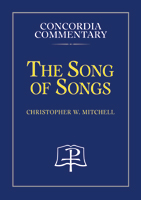
In recent years, several articles and commentaries on the book Song of Songs have been published worldwide in which this line is advocated. A place of honor among the commentaries to which this applies is that of Christopher W. Mitchell in the series Concordia Commentary. This series is written by authors most of whom belong to the Lutheran Church—Missouri Synod, a Lutheran church in America that adheres steadfastly to Scripture and the Lutheran Confessions. Mitchell himself is the editor of this series.
I cannot help but mention that I feel a spiritual bond with Mitchell through the email correspondence I have had with him for years, which arose in response to a review I wrote of a volume in the Concordia Commentary. If I ever have the opportunity to visit the United States again, I certainly hope to visit St. Louis.
Undoubtedly, there are differences between the Reformed and Lutheran confessional writings, but what unites them is the message of Law and Gospel, of justification by faith alone. That message permeates the volumes of the Concordia Commentary.
In reviews of books in this series I have already pointed out more than once that what makes this series so attractive is that the unreserved acceptance of the infallibility of Scripture goes hand in hand with an explanation that is of a high academic level (I am thinking of the sections in which Hebrew and Greek words and constructions are analyzed) and that the explanation offers numerous handles for preaching. This series is an example of the conviction that theology as a science must serve godliness.
Because each section of commentary in which attention is paid to the source text is separated from other sections, even those who do not master the original languages can profitably use the volumes of this series. The volumes are expensive, but you really get value for your money. I would especially point this out to colleagues and students. Anyone who uses these commentaries can leave many others unread.
*
The structure and content of the commentary
No one in church history has written such an extensive commentary on the Epistle to the Hebrews as John Owen. Now, when it comes to the Song of Songs, this applies to Mitchell, and as with Owen, the extensiveness does not detract from the value of the meaning of the exposition, but rather increases its value. As is the case with all volumes of the Concordia Commentary series, the volume on the Song of Songs opens with an introduction. However, no introduction is as broad as this one. It contains 543 pages, mind you. Many issues are discussed in this very extensive introduction, which consists of ten chapters. The reader can choose to consult the chapters separately without any problem.
After Mitchell has indicated why the book Song of Songs is relevant in our time, he gives an extensive justification of his approach. He characterizes it as Christological and analogical, and indicates that the Song of Songs was also written from this perspective. The love between God and His people, or Christ and His church, is a model for the love between a man and a woman. Mitchell bases his hermeneutics on the principle that Scripture forms a unity and can therefore be its own interpreter. In his explanation, he benefits from insights from church fathers and orthodox Lutheran theologians.
Two chapters from the introduction are devoted to the history of the interpretation of the Song of Songs and its use in the church. Since the Enlightenment it has been claimed by many that the book is purely a collection of wedding poems and that with this new view the book has been freed from the shackles of traditional Jewish and Christian exegesis. The author rightly disputes that view and correctly argues that this new view does not do justice to the original meaning of the book. Within Protestantism, Lutheranism and Anglicanism have had lectionary schedules for fixed Scripture readings from the beginning. The book of Song of Songs is almost always missing, Mitchell notes. He expresses the hope that this will change in the future. I note that the book of Song of Songs does not appear in the schedule of Scripture readings that can be found in the Book of Common Prayer of the Anglican Church. In hymns there are more frequent allusions to the Song of Songs. The author mentions, among other things, “How sweet the name of Jesus sounds (O Jesus, how trusting and sweet does Your name sound to me in the ear),” which is based on Song of Songs 1:3. I would also like to point out that in the Bible commentary of Karl August Dächsel (this commentary was translated into Dutch in the nineteenth century. In the Dutch translation passages from other German and Dutch Bible expositors are added. In former days this commentary was widely used in Dutch circles that adhered to the infallibility/inerrancy of the Scriptures and the Reformed confessions) in Song of Songs 2:4 a hymn/poem can be found that connects the words: “He leads me into the wine house” with the use of the Lord’s Supper:
I may be with Him in the wine house,
There He refreshes me with sweet wine,
That flows from His wounds.
And when I forget myself,
All I know then is,
He died for my sins.
*
The nature of the book Song of Songs
The Song of Songs, according to its own testimony, sings of the love which even death and the grave cannot defeat. It is a fire whose coals can be described as the flames of the LORD (Song of Songs 8:6). The author rightly asks the question of which love, apart from the love of Christ for His church, can it be said that death cannot win?
This does not exclude, but implies, for the author that the Song of Songs also provides lessons for marriage and preparation for marriage. The daughters of Jerusalem call upon people, both before marriage and after marriage, not to arouse or awaken love before it pleases her. This is a call not to behave as if married and cohabitate before marriage.
The book Song of Songs is a testimony that the gift of sexuality may not be enjoyed before marriage but only within marriage. In metaphorical language, the bride testifies that she entered marriage as a virgin and that she remained faithful to her husband in marriage (Song of Solomon 4:12–5:10; 8:10). Mitchell notes that because of this teaching of the bride, the book Song of Songs rightly has a place among wisdom literature. The core of wisdom is the fear of the LORD and this also includes taking to heart the biblical testimony about marriage and sexuality.
*
How should we view marriage?
The second chapter of the introduction is devoted to the question of how we should view marriage. Several issues then emerge that are certainly not derived only from the book of Song of Songs. In this chapter, Song of Songs is viewed in the context of the entire biblical testimony about marriage. Marriage as a creation order should be a prophetic sign and an analogy of the relationship between God and His people and Christ and His church, even after the Fall. For example, Solomon sings about his relationship with the Shulammite. In the light of salvation history and its progression, the marriage of Solomon and the Shulammite, the author argues, had a unique character.
*
The language and vocabulary of the book Song of Songs
The Hebrew of the Song of Songs shares certain characteristics with Proverbs, Ecclesiastes and a number of other passages from the Old Testament. It has long been thought that it was written in a Northern Hebrew dialect, but there is too little evidence to assume this. In any case, no decisive argument can be derived from the Hebrew of the Song of Songs for its dating and certainly not for a late dating. The Hebrew of the Song of Songs shows Aramaic influences, but we must not forget that the influence of Aramaic became much more extensive after the Babylonian exile, but did not begin then. Aramaic is no less ancient than Hebrew. There are many similarities between linguistic characteristics of the Song of Songs and those of Ugaritic texts from the second millennium BC.
In the Song of Songs, the bride is usually the one speaking. She calls her bridegroom “(my) beloved” twenty-six times. The Hebrew word dôd that is used here refers exclusively to the bridegroom and only occurs in the book of Song of Songs. In total, we find this word thirty-three times. Dôdi (dôd with the first person suffix) means first of all “he who loves me.” In the book of Song of Songs, the bridegroom’s excellent love is sung above all (Song of Songs 1:2). This does not mean that the connotation that the bride loves the bridegroom in response to his love should be excluded. After all, the bride repeatedly calls the bridegroom: “the one my soul loves” (Song of Songs 1:7; 3:1, 3 and 4). Mitchell points out that dôd can be an allusion to David. In the so-called defective spelling of this name that was common until the transition from Standard Biblical Hebrew to Late Biblical Hebrew, dôd has the same consonants as David. In addition, there is a relationship with the name Jedidjah that Solomon received as an affectionate name from the prophet Nathan.
The groom calls his bride (a feminine term for “friend” that could be rendered) “girlfriend” nine times and once the bride declares that the bridegroom is her “friend.” The word “girlfriend” occurs, apart from a variant in Judges 11:37–38 and Psalm 45, only in the Song of Songs. In fact, the translations “girlfriend” and “friend” are too weak. The Hebrew terms refer to a deep, passionate love. In Song of Songs 5:1 Solomon and the Shulammite are addressed as “friends.” Then we must assume that the daughters of Jerusalem are speaking.
The Hebrew word for “gazelles” that we encounter in Song of Songs 2:7 and 3:5 has the same spelling and pronunciation as “armies” or “hosts.” They are, to use the linguistic term for it, homonyms. The expression “does of the field” corresponds phonetically and orthographically to some extent with the name “God Almighty.” The author points out that in the Septuagint, the Targum and Midrash Rabbah we read the words: “I adjure you by the gazelles and the does of the field” as an appeal to the LORD as Creator and Redeemer. Creation is namely an imprint of God’s power as Creator and the God of Israel has also revealed Himself in His redemptive action at the exodus and the entry into Canaan. The Septuagint translates: “by the powers and forces of the field.” In the Targum Song of Songs 2:7 is paraphrased as follows: “I charge you, O congregation of Israel, by the Lord of hosts, and by the mighty men of the land of Israel, that you do not go up into the land of Canaan, until it is the Lord’s will, and until the whole generation of the men of war be utterly consumed from among the camp, as your brethren the sons of Ephraim supposed, when they came out of Egypt thirty years before the time came, and they fell among the Philistines, who dwelt in Gath, and they slew them. But wait for the period of forty years, and afterward your sons shall go in and possess it.”
Mitchell points out that the translations differ with regard to the Hebrew words ‘ammi-nadib in Song of Solomon 6:12. The Statenvertaling, the Dutch equivalent of King James Version, has here “my voluntary people.” Following the Septuagint and the Vulgate, the translators of the King James Version thought of the proper name Amminadib/Amminanab. Now, the Hebrew word ‘am can mean not only “people” but also “kinsman.” The word nadib can be understood not only as “willing” but also as “prince/ruler.” Mitchell prefers this. He therefore translates: “before I knew it, my soul/desire was set upon the chariots of my kinsman-prince.” In the context of the book Song of Songs, this view fits better.
*
The historical setting of the Song of Songs
The historical background of the book Song of Songs is related to its time of origin. Egyptian love songs with which the book Song of Songs shows formal parallels on a number of points date from the end of the second millennium BC. Mitchell takes the authorship of Solomon very seriously. Solomon was known, among other things, for his attention to flora and fauna (1 Kings 4:33). This is in keeping with the fact that the book Song of Songs contains detailed and varied descriptions of fauna and especially flora.
When Solomon married the Shulammite, he already had sixty queens and eighty concubines. In this, Solomon is certainly not a reflection of the God of Israel and a type of the coming Christ. Who is the Shulammite, as the bride is called in Song of Songs 6:13? Traditionally, it has been thought of as the daughter of Pharaoh. This ties in with the remark of the daughters of Jerusalem that the bride ascends/comes up from the desert (Song 3:6; 8:5). The rabbinical exegesis here thinks of the desert to Canaan that followed the exodus from Egypt.
Mitchell argues that we can think of Abishag the Shunammite (1 Kings 1:3, 15; 2:17, 21–22). Sometimes in the Semitic languages the letters lamed and nun can be interchanged. The modern equivalent for the place called Shunem is Sûlam. For her name most manuscripts of the Vulgate read Sulamitis, but a few have Sunamitis. The author then shows that in any case we must see allusions in the name Shulammite to Solomon, to shalom (“peace”; see Song 8:10) and to Jerusalem. He points out that the name “the Shulammite” can also mean “the perfect one.” Then an adjective or passive participle related to the verb shalem is assumed.
In Song of Solomon 8:8, “We have a little sister, and she has no breasts; what shall we do for our sister in the day when it is spoken for her?” the question is who is speaking here and who is being spoken of. The speakers can best be thought of as the brothers of the bride. Brothers had the task of guarding the virginity of their sisters and the rest fits in with that. In Song of Solomon 8:9 the brothers then say: “If she be a wall, we will build upon her a battlement of silver; and if she be a door, we will enclose her round about with boards of cedar,” while in Song of Solomon 8:10 the bride testifies, “I am a wall, and my breasts are like towers. Then I was in His sight as one who finds peace.” When it comes to “a little sister” it has been thought that the brothers of the bride contemptuously call the bride that. However, it is also possible that there is a flashback. A statement that the brothers made in the past is quoted. It is often assumed that it concerns a younger sister of the bride. I would like to point out that in church history the bride has been thought of as the church of the old covenant and the little sister as the church of the new covenant.
In Song of Songs 1:6 the bride testifies that she has not tended the vineyard that she has and that her brothers were angry with her for that reason. Comparison with Song of Songs 8:12 teaches us that she has entrusted the vineyard to other keepers for a reward. Apparently she wanted to meet her beloved. In Song of Songs 8:12 we read that she gives the produce of her vineyard to Solomon after deducting the wages for the keepers. Shulammith gives everything she has to Solomon.
*
The structure
When it comes to the structure of the book Song of Songs, various proposals have been made that largely overlap. Mitchell divides the Song of Songs into two main parts. He sees Song of Songs 5:1 as a pivotal point. Here the bridegroom expresses that he has fulfilled the desire for union with his bride. In the first part, the love between bride and groom in the time of betrothal is sung about and in the second part, the love between husband and wife in marriage.
In further subdivisions, Mitchell adheres as much as possible to the twenty indications for division (the so-called setumahs) of the Masoretes (the copyists of the Hebrew text of the Old Testament who provided the consonantal text with vowel signs and accent marks) with the exception of Song of Songs 1:14; 2:13, 14; 3:8 and 6:9. He arrives at the following division:
I 1:2–17 Union (1:2–4); betrothal (1:5–8); wedding (1:9–11); union (1:12–17)
II 2:1–17 Wedding and union (2:1–7); betrothal (2:8–15); wedding (2:16); union (2:17)
III 3:1–4:7 Betrothal (3:1–5); wedding procession (3:6–11); wedding and union (4:1–7)
IV 4:8–51 Betrothal (4:8); wedding including description of Shulammith by Solomon (4:9–15); union (4:16–5:1)
V 5:2–6:10 Nightly search of the woman for her husband (5:2–8); description of Solomon by Shulammith (5:9–16); longing transition (6:1–3); second description of Shulammith by Solomon (6:4–10)
VI 6:11–8–4 Seek and be found (6:11–13); third description of Shulammite by Solomon (7:1–9); Shulammite wishes that she could show her love more openly (8:1–4)
VII 8:5–14 Conclusion. Brief transition (8:5); climax of love declaration (8:6–7); exhortatory application (8:8–14)
Mitchell notes in connection with the descriptions that in Song 5:10–14 Solomon is described from his head to his feet and in Song 7:1–5 Shulammite is described from the feet to the head. In Song 4:9–11 the Shulammite is described only from her eyes and lips to her neck, and in Song 6:5–7 only features of her head.
*
Scriptural data relevant to the interpretation of the book Song of Songs
Mitchell places the book Song of Songs in the context of the biblical testimony that begins with creation and ends with the consummation at Christ’s return. He notes that the images of trees, flowers and a stream of water evoke memories of paradise. Mitchell does not mention this, but in our country we know the expression that marriage is a flower that has remained from paradise. Marriage is in any case a creation order and marriage may have something paradisiacal if it is truly a reflection of the love between Christ and His church. Then everyone knows that in practice this is not always the case, but it does apply to the love between man/bridegroom and woman/bride that is sung about in the book Song of Songs. Mitchell draws a line from paradise via the cross and resurrection of Christ to His return. The bond between Christ and His church will ultimately culminate in the wedding of the Lamb. The new paradise will surpass the old paradise in glory. The images of water and trees in Song of Songs therefore also refer to eternal glory. In the longing of the bride for her bridegroom we hear the longing of Christ’s church for the return of her King. The prayer with which Song of Songs concludes: “Come quickly, my beloved! and be thou like a roe or a young hart upon the mountains of spices” (Song of Songs 8:14) may be read as a prayer for the return of Christ.
*
The Sacraments
Mitchell also finds references to the sacraments in the book of Song of Songs. He points out that the Song of Songs is frequently quoted in the baptismal instruction of Ambrose and Cyril of Alexandria. In his catechetical discourses, Cyril of Jerusalem could speak of the baptismal waters bearing Christ (Song of Songs 4:12, 15) and their odor (Song of Songs 1:3, 12; 4:10–11; 7:8, 13). Mitchell himself also sees in the climax of the description of love in the Song of Songs, namely, “Many waters could not quench this love; yes, the rivers would not drown it” (Song of Songs 8:7a) also an allusion to baptism.
The author points out that the centuries have found many more allusions to the Lord’s Supper in the book of Song of Songs. Song of Songs 2:4 was already discussed above. I will now mention a number of texts to which Mitchell points in this connection. The first is Song of Songs 1:2: “Let him kiss me with the kisses of his mouth; for your love is better than wine.” Song of Songs 2:5: “Stay me with flagons, comfort me with apples, for I am sick with love,” and Song of Songs 5:1c: “Eat, friends! drink, and be drunk with love.”
The great emphasis on the sacraments, in which the working of the Word and of the sacraments are less distinguished than in reformed Protestantism, is characteristic of Lutheranism. We also notice this in Mitchell’s commentary. I would add immediately that the author does not fail to note that receiving the sacraments is only a blessing to us if it happens in faith. Then he leaves no misunderstanding that faith is a gift from God. A Christian knows that he is dependent on God’s grace from the beginning to the end of his career (cf. Song of Songs 1:4; 2:4). Solomon’s role in the book of Song of Songs resembles that of Christ in relation to His church, and the Shulammite’s role resembles that of the church in relation to Christ. The roles of Solomon and the Shulammite cannot be confused. In Song of Songs 5:2–8, the Shulammite tells how she did not heed Solomon’s call. Nevertheless, he let herself be found by her again (Song of Songs 6:3 ff.).
I can recommend Mitchell’s commentary to anyone who has a command of the English language and wants to delve deeply into the book Song of Songs. If you don’t know Hebrew, you should simply skip the first sections (textual notes) of the explanations. For preachers, this explanation is truly a goldmine because of the thorough analysis of the Hebrew text, the solid exposition and the rich applications for the life of the church and of Christians personally.
Solomon’s Song of Songs has a deep message of love that God gives and works, of longing and enjoying the hidden relationship with God through Christ and of looking forward to eternity. Mitchell’s expostion can help to gain even more insight into this.
Christopher W. Mitchell, The Song of Songs, Concordia Commentary (St. Louis: Concordia Publishing House, 2003), hardcover 1,344 pages, $64.99 (ISBN 978-0-570-06289-9)
 Dr. P. de Vries - artikelen en opinie